
 Doc Summary

How to mark a control as inactive (for example when it has failed or is no longer operating) and what that does to linked risks.
Applies to: Users who can edit the control · Module: Controls
Opening the Control #
Select Controls in the left-hand menu and select the control on the dashboard.
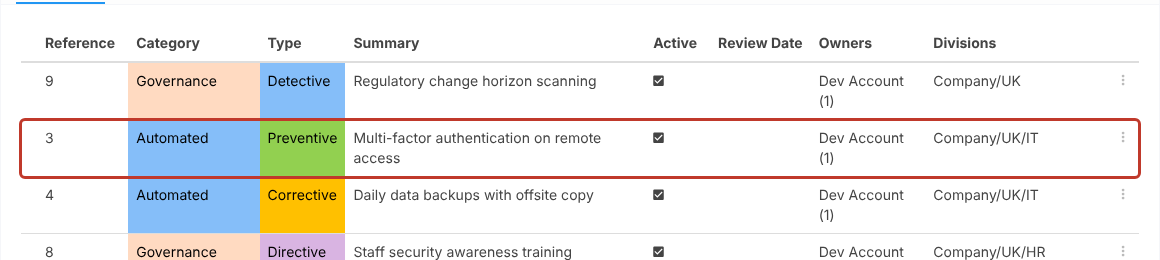
Select the Edit Control tab.

Deactivating a Control #
New controls are Active by default (the button is blue with a tick).

Select Active to untick it.

Select Save at the top right, or the pencil to save and stay on the control.
What Happens to Linked Risks #
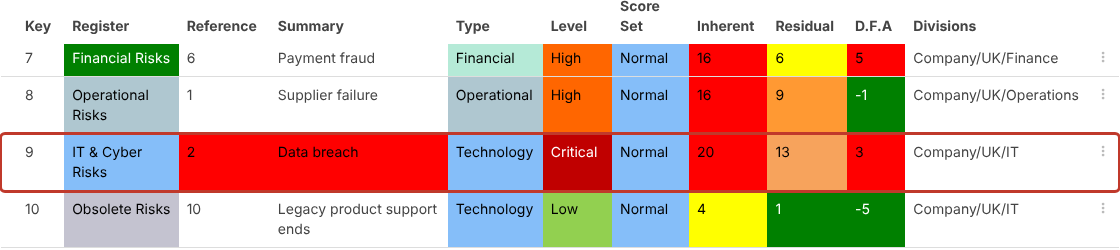
This needs the Risk Register module. When a control linked to a risk is inactive, the risk’s residual score on the dashboard moves back towards its inherent score by the control’s weighting. See Control Weightings.
On the Risk Registers dashboard, any risk with an inactive control is highlighted in red. In this example the Data breach risk’s residual score has gone up from 12 to 13 because a control weighted at 30% is inactive.
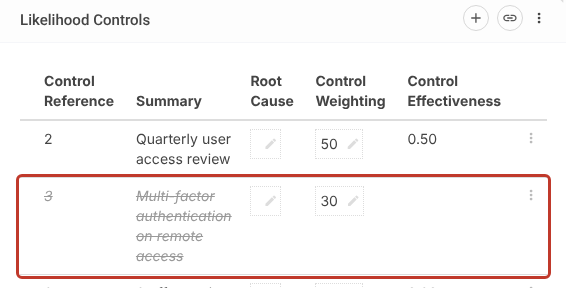
Open the risk and the inactive control is shown struck through on the Controls tab.
Note: The scores saved on the risk’s Scores tab don’t change. Only the dashboard (dynamic) residual reflects the inactive control. See Why are certain Risk Scores showing differently on the dashboard?.
Inactive controls are also listed on the Inactive Controls tab of the Controls dashboard.
Activating a Control #
Open the control, select the Edit Control tab, select Active so it shows a tick again, then Save. Linked risks go back to their normal residual scores and are no longer highlighted.