
 Doc Summary

How document statuses control who can see a document and its file.
Applies to: all Document Management users · Module: Document Management
The Three Kinds of Status #
Every document revision has a status. Each status in the list is one of three kinds, set by its flags (see Setting Up Document Statuses):
| Kind | How it is flagged | Meaning | Who can see it |
|---|---|---|---|
| Draft | Draft? ticked | A new version that has not yet been approved. | The document owners and admins only. Other users do not know the draft exists and cannot open its file. |
| Published | Published? ticked | The approved, official version. | Every user whose role gives access to the module. They can download the file from the list or the record and always get the latest published revision. |
| Obsolete | Neither ticked | A version or document that is no longer used but kept for the record. | Admins only. |
Setting a Revision’s Status #
- Open the document and click the Edit Document tab.
- Under Document Revision, choose the Status. The list shows your organisation’s statuses with their colours.
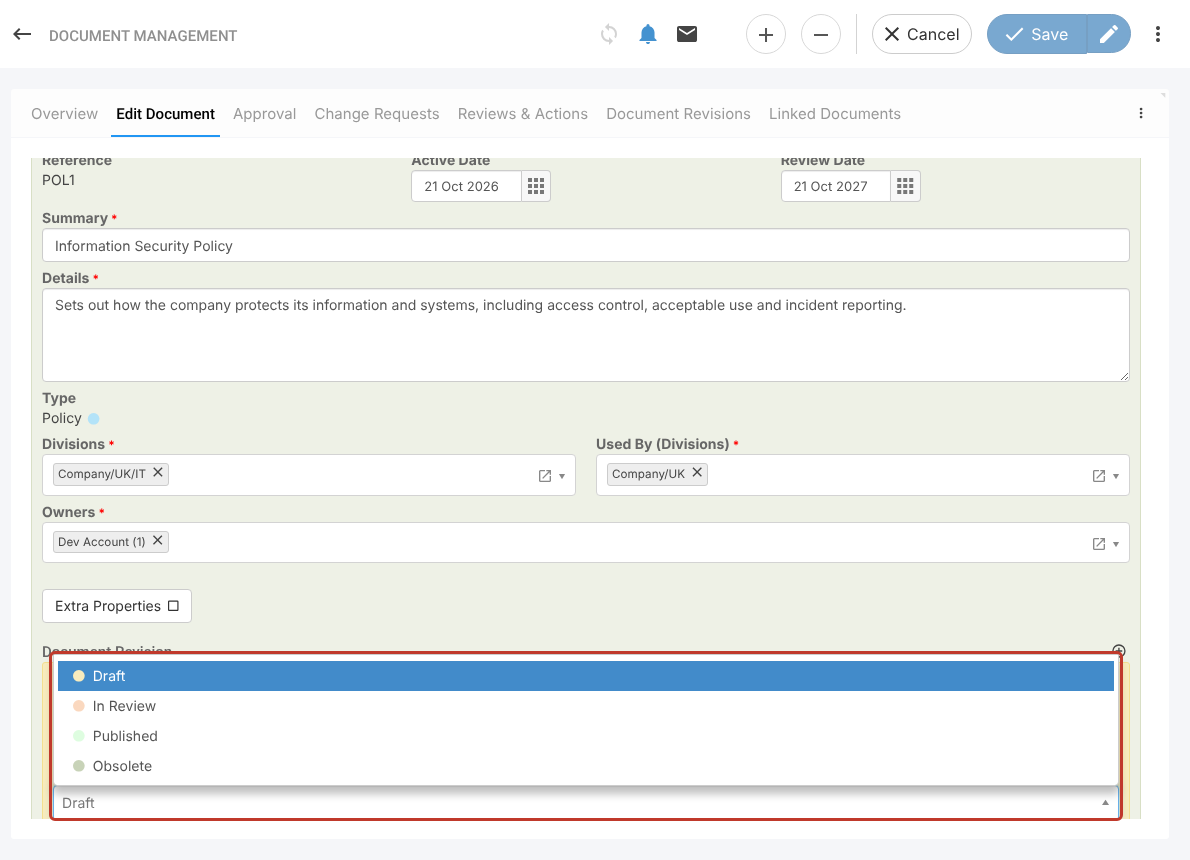
- Click Save.
Draft Documents #
New revisions are created as Draft automatically. A draft sits between the current published version and the next one, while it waits for approval. Your organisation can have several draft statuses (for example Draft and In Review).
Published Documents #
Only one status can be marked as Published, although its name can be anything. A published revision has been through approval, with an audit trail of who approved it and when. When a document has several revisions, users get the newest published one.
Obsolete Documents #
Use an obsolete status when a document is no longer needed but should stay on dashboards and reports. To remove a document from dashboards and reports completely, delete (archive) the record instead.