
 Doc Summary

How to weight the controls on a risk, and how weightings affect the risk score. Requires the Risk Register module.
Applies to: Users who can edit the risk · Module: Register Risks and Controls
What a Weighting Does #
A control weighting says how much of the risk’s reduction depends on that control. It only changes the score when a control is inactive: the risk’s residual moves back towards its inherent score by the weighting of the inactive control.
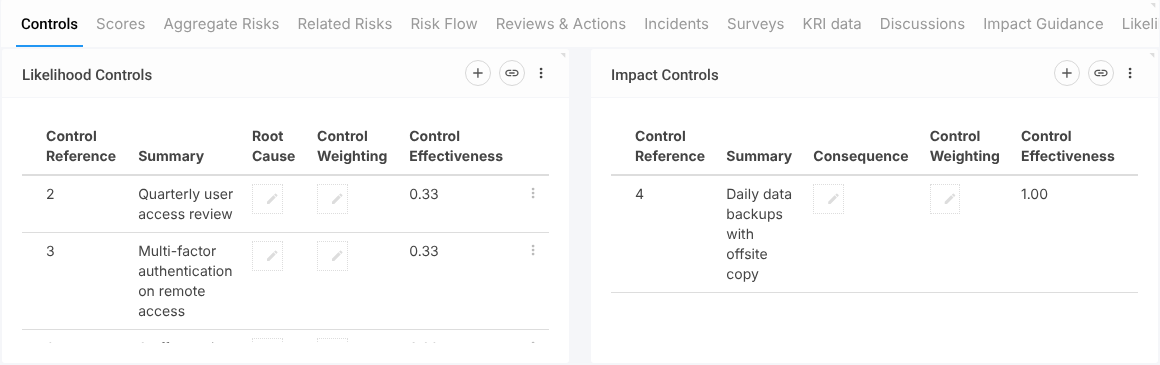
By default every control on a grid is weighted equally. With three likelihood controls each one counts for a third, shown as 0.33 in Control Effectiveness.
You can give one control more weight than another, for example 50, 30 and 20.
Adding a Weighting #
Open the risk from the Risk Registers dashboard. On the Controls tab, select the pencil in the Control Weighting column of a control, type a value and press Enter.
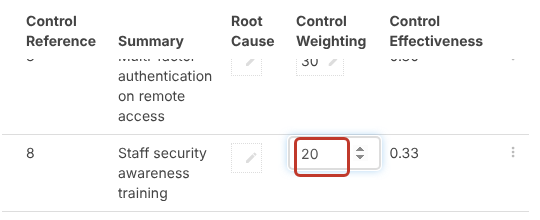
Repeat for the other controls. Control Effectiveness updates to show each control’s share.
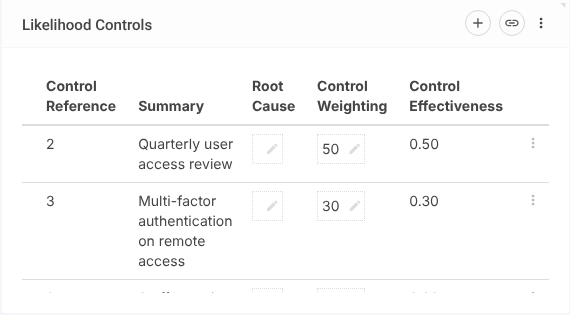
Select Save at the top right, or the pencil to save and stay on the risk.

Example: The Data breach risk has a residual likelihood of 3 and an inherent likelihood of 4. If the multi-factor authentication control (weighted 30) becomes inactive, the dashboard residual rises from 12 to 13.
Removing a Weighting #
Select the weighting, delete the value and press Enter, then save. Without a weighting the control goes back to an equal share.