 Doc Summary

An overview of the main parts of the Symbiant screen: the sidebar, the head bar and the module dashboard.
Applies to: All users · Module: All
The Sidebar #
The sidebar on the left is where you open Modules and Reports. Each item is a module (for example Incidents). Click one to open its dashboard.
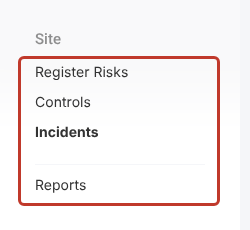
You only see the modules your role gives you access to, so your sidebar may be longer or shorter than the one shown here.
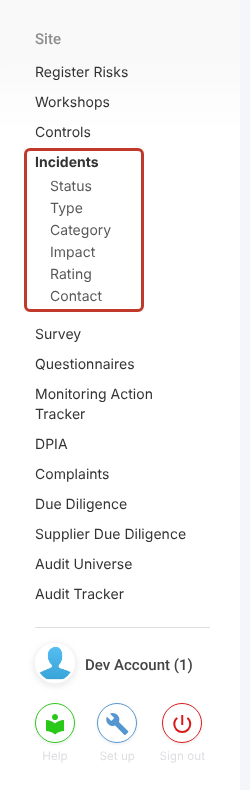
Administrators, and some other roles, also see that module’s Sub-Menu Items (stubs) indented underneath it when it’s open (for example Status, Type and Category). Stubs hold the drop-down lists the module uses.
The Bottom of the Sidebar #
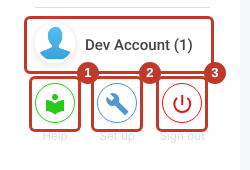
Your name is shown at the bottom left. Click it to see your Account Details. What sits under your name depends on whether you are an administrator.
Most users see:
- Help: opens the Symbiant knowledge base (or your company’s own help page, if your administrator has changed the link).
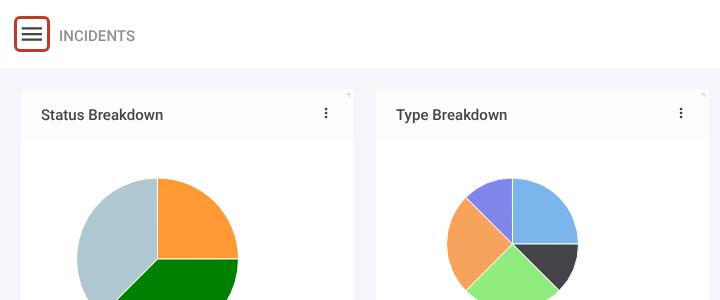
- Hide Menu: hides the sidebar. This is handy on a small screen, where the sidebar covers part of the page. Click the menu icon (three lines) at the top left to show it again.
- Sign out: signs you out of Symbiant.
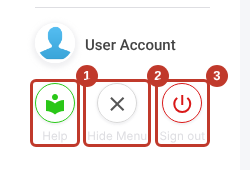
Administrators see Set up (the spanner icon) in place of Hide Menu (2). Set up opens the admin area.
Hiding and Showing the Sidebar #
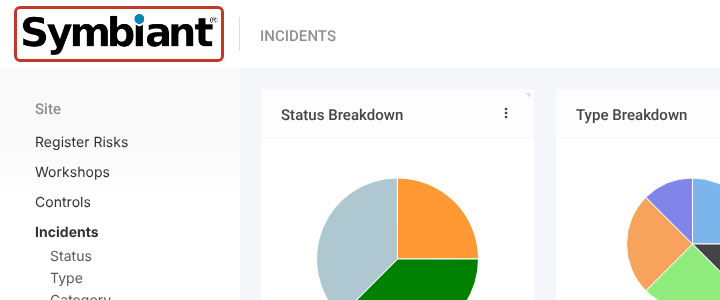
To give the page more room, click the Symbiant logo (or your company logo) at the top left to hide the sidebar.
To show the sidebar again, click the menu icon (three lines) at the top left.
The Head Bar #

- Logo: hides or shows the sidebar.
- Module name: shows which module you are in. When a record is open, a back arrow appears next to it to return to the module’s dashboard.
- Sync: shows whether your screen is in sync with the server. While you are editing it shows “Not synced with server” until you save, and it holds Undo for your last change. See Editing a Record.
- Bell: notifications. It lights up after a save or an error; click it to read the message. See Notifications and Messages.
- Envelope: in-app messages.
- Plus (+): adds a new record to the module you are in. Inside a stub, it adds a new drop-down option.
- Search: searches the records in the current module for full or partial words.
- Options (⋮): the module’s options menu (see below).
Note: When a record is open the head bar also shows − (delete the record, if your role allows it), Cancel, Save and the pencil (Save and Edit). See Saving a Record: Save, Save and Edit, Cancel and Undo.
The Options Menu (⋮) #
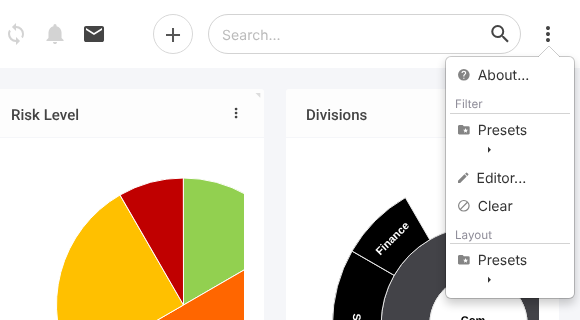
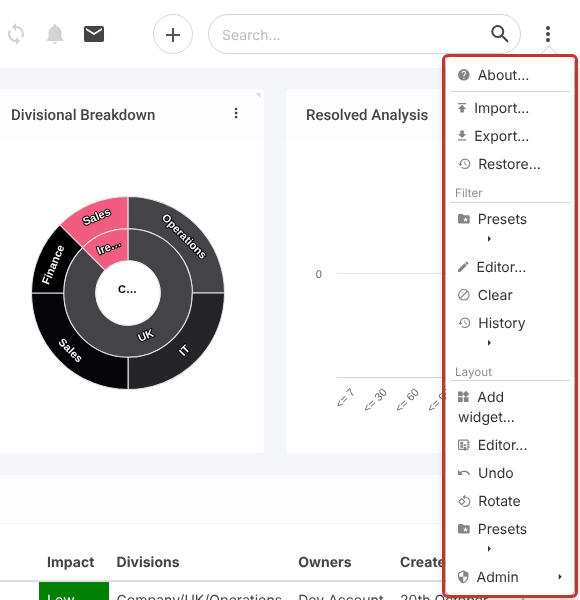
The three dots at the top right open the module’s options. What you see depends on your role.
Most users see a short menu:
- About…: information about the module.
- Filter: Presets (saved filters), Editor… (advanced filter) and Clear.
- Layout: Presets (saved dashboard layouts).
Administrators, and users whose role allows it, also see:
- Import… and Export…: bring records in from a CSV file or download the records shown.
- API token: for connecting other systems to Symbiant.
- Restore…: bring back deleted records.
- Filter > History: view the module as it was at an earlier time.
- Layout: Add widget…, Editor…, Undo and Rotate.
- Admin: for loading and saving the views everyone sees.
The Module Dashboard #
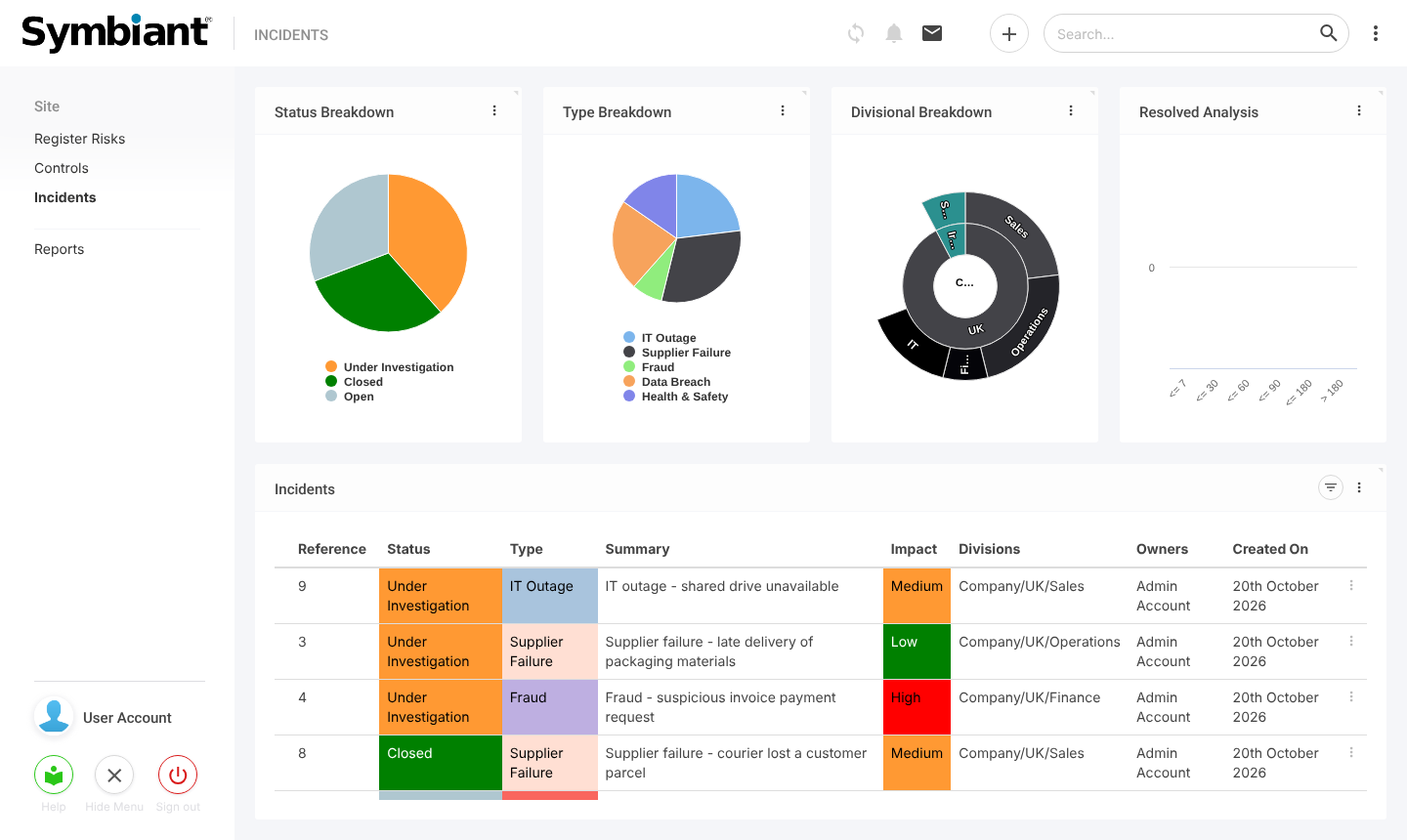
The rest of the screen shows the module you have selected. This is the module’s Dashboard (also called the List View): charts at the top and a grid of records underneath. The example below is the Incidents dashboard. Click a chart segment to filter the records, or click a row to open a record.
Collapsing an Element #
Any element on a dashboard (a chart or a grid) can be collapsed to save space. Click the three dots (⋮) on the element and select Collapse.
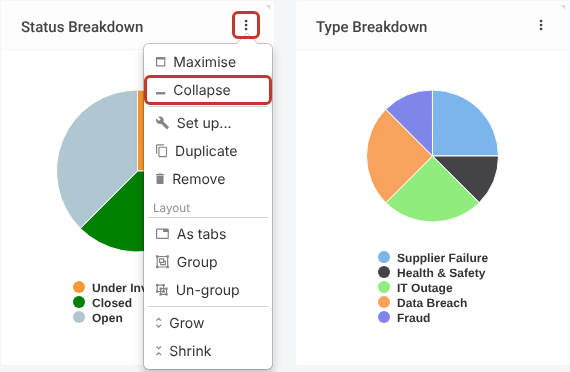
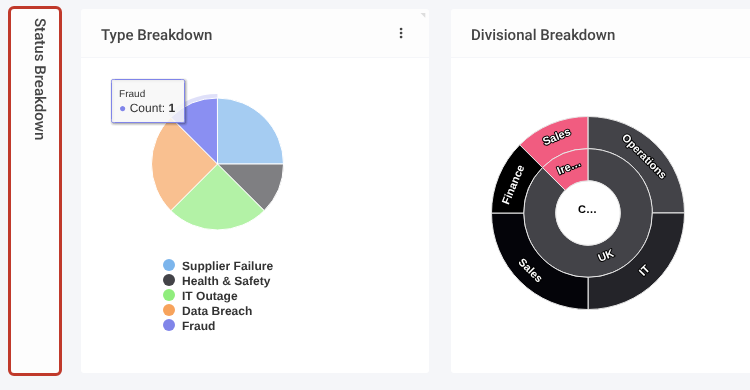
The element shrinks to a narrow bar. It stays collapsed until you leave the module. To show it again, click the bar.