
Skip to content
Symbiant System Black Logo
  • Home
  • Knowledge Base
  • Symbiant Website
  • Symbiant Changelog
  • Submit a Ticket
  • My Support Tickets
  • Home
  • Knowledge Base
  • Symbiant Website
  • Symbiant Changelog
  • Submit a Ticket
  • My Support Tickets
Popular Keywords importuserdivisionsamlimport risk

Admin Basics

  • Sharing Dashboard Layouts with Other Users
  • Setup Mode/Admin Menu
  • Creating/Adding Users
  • Transferring Ownership from One User to Another (Assuming)
  • Making a User Active/Inactive
  • Delete a User
  • Changing a Record Reference
  • Managing Drop-Downs, Multi-Selects, and Multi-Levels
  • Resetting a User’s Password
  • Checking System Attachment Storage
  • Database History & Restoring Historical Records
  • Restoring a Deleted Record (Archived)
  • Audit Trails
  • Email Log Viewer
  • System Menu Layout & Options

System Translations

  • Adding a Translation Pack
  • Editing a Translation Pack
  • Mass Editing a Newly Created Translation Pack
  • Assigning a Translation Pack to a User
  • Exporting a Translation Pack
  • Importing a Translation Pack
  • Adding a Default Translation Pack
  • Creating a Locale Specific View (Translated View)
  • Editing a Locale Specific View (Translated View)

Importing Data

  • Preparing Data for Import (Default)
  • Imports with Hierarchical Data
  • Importing Data (Generic)
  • Preparing Data for Import (Risks)
  • Importing Data (Risk Register Specific)
  • Preparing Data for Import (Users)
  • Importing Users
  • Importing Divisions
  • Importing Errors & Issues

Automated Emails (Task Based)

  • How Automated Emails Work (Triggers and Schedules)
  • Activating and Deactivating an Automated Email (Trigger) and (Scheduler)
  • Creating an Automated Email โ€“ When a Record is Created (Trigger)
  • Creating an Automated Email โ€“ When a Record is Updated (Trigger)
  • Creating an Automated Email โ€“ When a Record is Deleted (Trigger)
  • How to Receive Module Specific Emails as System Admin (Trigger) and (Scheduler)
  • Editing an Automated Email โ€“ Sending to a Different Module Role (E.g. Risk Manager) (Trigger)
  • Editing an Automated Email โ€“ Sending to a Record User (Trigger)

Automated Email Reminders (Time Based)

  • How Automated Emails Work (Triggers and Schedules)
  • Activating and Deactivating an Automated Email (Trigger) and (Scheduler)
  • Creating an Automated Email Reminder โ€“ When a Record is Due (Scheduler)
  • Creating an Automated Email Reminder โ€“ When a Record is Overdue (Scheduler)
  • Setting up Recurring Schedules
  • How to Receive Module Specific Emails as System Admin (Trigger) and (Scheduler)
  • Editing an Automated Email Reminder โ€“ Sending to a Different Module Role (E.g. Risk Manager) (Scheduler)
  • Editing an Automated Email Reminder โ€“ Sending to a Record User (Scheduler)

System Views

  • Editing a Dashboard Chart
  • Sharing Dashboard Layouts with Other Users
  • System Views (Quick Explainer)
  • Creating Your Own Custom Views
  • View Editor Tool Overview
  • Editing a View
  • How to Hide/Unhide Fields
  • Loading/Saving a Particular User’s View
  • What are Widgets?
  • Adding, Removing and Editing a Grid Column
  • Adding Help Tips & Placeholder text
  • Modifying a User Field to Limit or Allow Specific Users
  • Modifying a Currency Field to Set Default

Exporting Data

  • Exporting Dashboard Data
  • Exporting Divisions
  • Exporting Users
  • Generating the System User Details Report

System Errors & Issues

  • Resolving System Issues
  • System Error Messages
  • Login Issues

Reporting Suite Tutorial

  • Creating a Word Report (Basic Data Output)
  • Creating an Excel Report (Basic Data Output)
  • Creating a PowerPoint Report (Basic Data Output)
  • Creating an Excel Tabular Report (Perfect for CSV)
  • Creating an Excel Audit Report (Audit Log Of Changes)
  • Adding a new column to an Excel Report
  • Removing a column in an Excel Report
  • Creating an Advanced Word Report (Adding Functions)
  • Advanced Report Coding (Using Owners, Divisions & Assignees in a Report)
  • Advanced Report Syntax
  • Advanced Filtering on Reports (Filtering Via Code)
  • Reporting Permissions

Advanced System Functionality

  • Symbiant API

Document Management (System Setup)

  • Setting Up Document Types
  • Setting Up Document Statuses
  • Document Storage Limits and File Sizes
View Categories
  • Home
  • Knowledge Base
  • Admin Information
  • System Views
  • System Views (Quick Explainer)

System Views (Quick Explainer)

0:00 / 1:12
  • View as Markdown Open this page as plain Markdown (opens in a new tab)
  • Open in ChatGPT Ask questions about this page (opens in a new tab)
  • Open in Claude Ask questions about this page (opens in a new tab)
  • Open in Google AI Studio Ask questions about this page (Google account required) (opens in a new tab)
AI Doc Summarizer Doc Summary
AI Doc Summarizer Thinking Thinking

Every module in Symbiant uses three kinds of view. This article shows what each one is for, so the other view articles make sense.

Applies to: All users ยท Module: any module (the examples use Register Risks)

The List View #

The List view is the first screen you see when you open a module, so it is often called the dashboard. It usually has charts at the top and a grid of records underneath. Clicking a chart segment filters the grid.
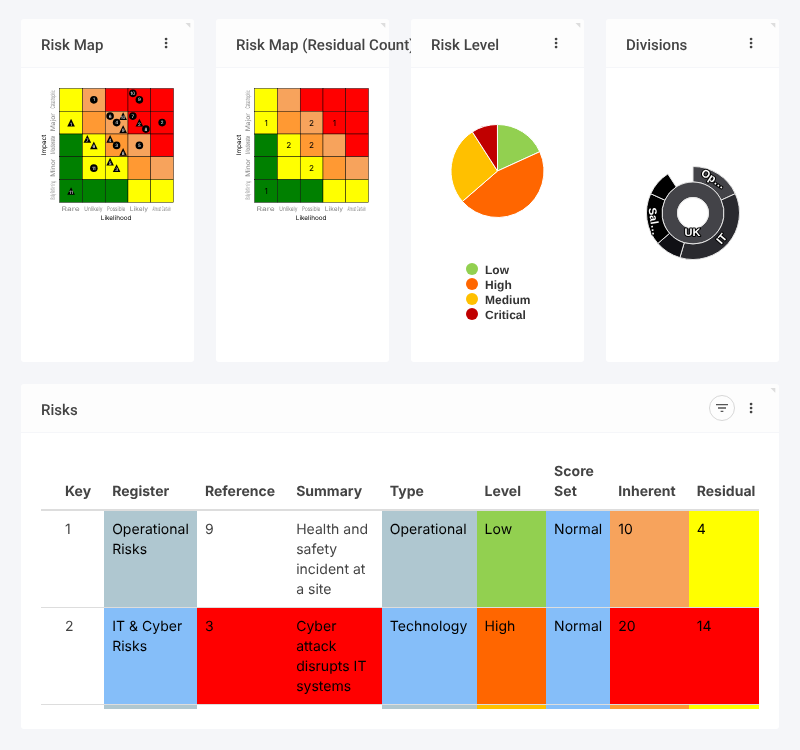
The Register Risks list view

The New View #

The New view opens when you click + at the top of the screen. It is the form you fill in to add a record: text boxes, drop-downs, dates, user pickers and so on.
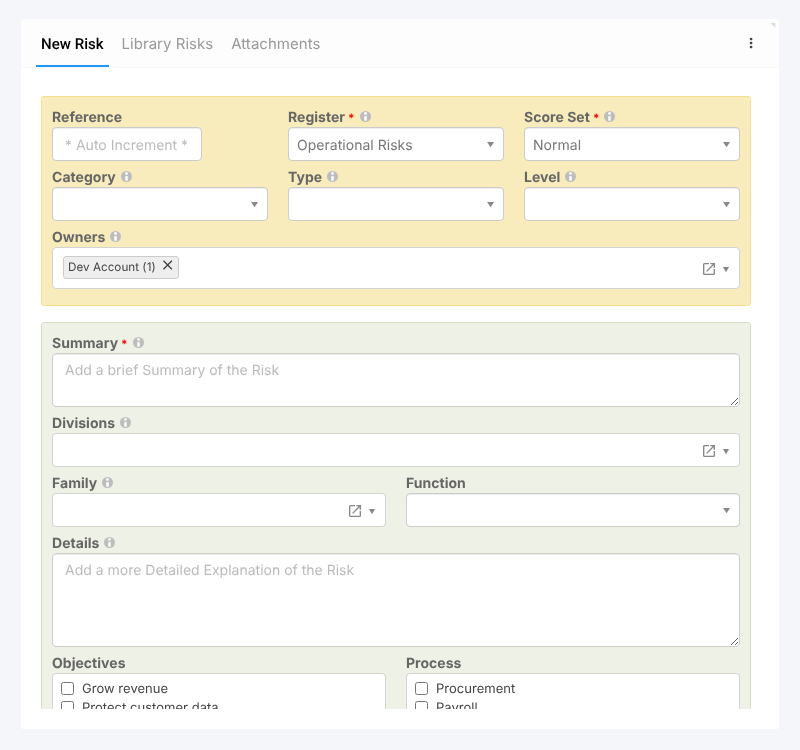
The New Risk view

The Details View #

The Details view opens when you click a record in the grid. It shows the record’s data and lets you edit it, with tabs and panels for related information such as controls, actions and attachments.
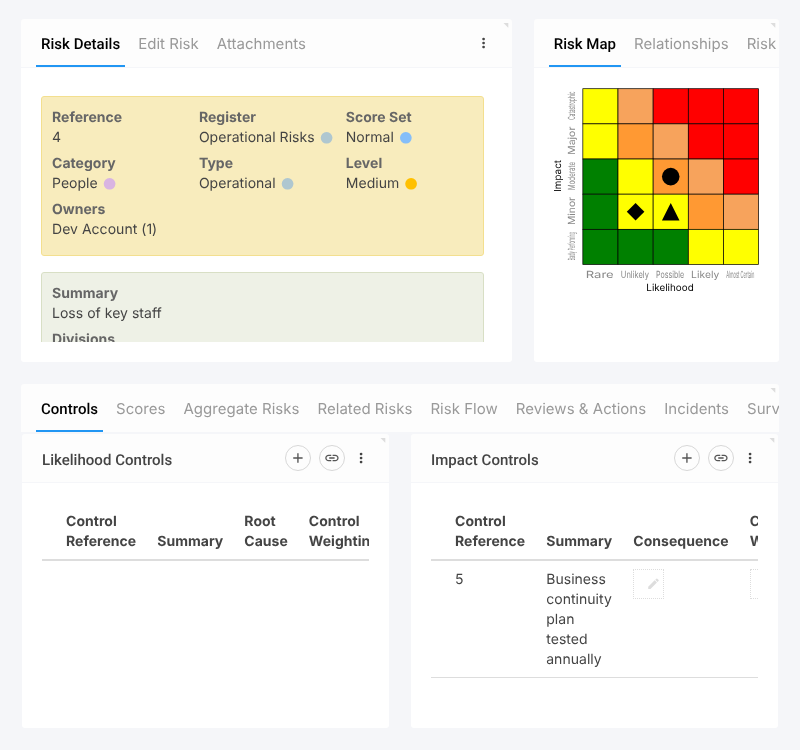
A risk's Details view

Who Sees Which View #

Each module ships with generic views. Administrators can copy and change them, then assign the copies to users, roles or divisions in Set up > Module Views. The Type column there shows whether a view is a List, New or Detail view.

Related articles #

  • View Editor Tool Overview
  • Creating Your Own Custom Views
  • Editing a View
Accounts, Setup, User, Views
Did this help?

Share This Article :

  • Facebook
  • X
  • LinkedIn
Require Additional Information? Please Contact Support

How can we help?

Updated on 30 October 2026
Sharing Dashboard Layouts with Other UsersCreating Your Own Custom Views
Table of Contents
  • The List View
  • The New View
  • The Details View
  • Who Sees Which View
  • Related articles
Symbiant System White Logo

20-22 Wenlock Road

London

N1 7GU

Linkedin
Telephone Numbers
  • UK - 0113 5263 755
  • Support - 0204 5514 735 option 2
  • USA - 347 991 7130
Information
  • Home
  • Knowledge Base
  • Symbiant Website
  • Submit A Ticket
  • Change Requests
  • Support Staff Login

Copyright ยฉ 2025 Symbiant All Rights Reserved - Risk, Audit and Compliance Management Software

We use cookies on our website to give you the most relevant experience by remembering your preferences and repeat visits. By clicking โ€œAccept Allโ€, you consent to the use of ALL the cookies. However, you may visit "Cookie Settings" to provide a controlled consent.
Cookie SettingsAccept All
Manage consent

Privacy Overview

This website uses cookies to improve your experience while you navigate through the website. Out of these, the cookies that are categorized as necessary are stored on your browser as they are essential for the working of basic functionalities of the website. We also use third-party cookies that help us analyze and understand how you use this website. These cookies will be stored in your browser only with your consent. You also have the option to opt-out of these cookies. But opting out of some of these cookies may affect your browsing experience.
Necessary
Always Enabled
Necessary cookies are absolutely essential for the website to function properly. These cookies ensure basic functionalities and security features of the website, anonymously.
CookieDurationDescription
cookielawinfo-checkbox-analytics11 monthsThis cookie is set by GDPR Cookie Consent plugin. The cookie is used to store the user consent for the cookies in the category "Analytics".
cookielawinfo-checkbox-functional11 monthsThe cookie is set by GDPR cookie consent to record the user consent for the cookies in the category "Functional".
cookielawinfo-checkbox-necessary11 monthsThis cookie is set by GDPR Cookie Consent plugin. The cookies is used to store the user consent for the cookies in the category "Necessary".
cookielawinfo-checkbox-others11 monthsThis cookie is set by GDPR Cookie Consent plugin. The cookie is used to store the user consent for the cookies in the category "Other.
cookielawinfo-checkbox-performance11 monthsThis cookie is set by GDPR Cookie Consent plugin. The cookie is used to store the user consent for the cookies in the category "Performance".
viewed_cookie_policy11 monthsThe cookie is set by the GDPR Cookie Consent plugin and is used to store whether or not user has consented to the use of cookies. It does not store any personal data.
Analytics
Analytical cookies are used to understand how visitors interact with the website. These cookies help provide information on metrics the number of visitors, bounce rate, traffic source, etc.
SAVE & ACCEPT
Loading...

Insert/edit link

Enter the destination URL

Or link to existing content

    No search term specified. Showing recent items. Search or use up and down arrow keys to select an item.