
Skip to content
Symbiant System Black Logo
  • Home
  • Knowledge Base
  • Symbiant Website
  • Symbiant Changelog
  • Submit a Ticket
  • My Support Tickets
  • Home
  • Knowledge Base
  • Symbiant Website
  • Symbiant Changelog
  • Submit a Ticket
  • My Support Tickets
Popular Keywords importuserdivisionsamlimport risk

Navigation & Accessibility

  • Notifications and Messages
  • Saving Filter and Layout Presets
  • System Navigation Overview
  • Dashboard Layout Tools
  • Filtering Data
  • Advanced Filtering

User Basics

  • Duplicating a Record
  • Saving a Record: Save, Save and Edit, Cancel and Undo
  • Action Progress Updates and Comments
  • Getting Started: Your First Login
  • Signing Out and Session Timeout
  • Workflow Statuses Explained
  • Glossary of Symbiant Terms
  • Adding a Record
  • Adding an Attachment
  • Editing a Record
  • Deleting a Record (Retractions)
  • Resetting your Password
  • Generating A Report
  • Filtering on Reports
  • Linking Records Between Modules
  • Unlinking Records from a Module
  • Reviews & Actions
  • Multi-Factor Authentication (Google Authenticator)

Risk Register Basics

  • Adding a Risk
  • Risk Universe
  • Tracking Risk Score Changes Over Time
  • Scoring a Risk (Inherent, Residual, Target & Appetite)
  • Risk Heat Map (Risk Matrix)
  • Risk Appetite Logic
  • Risk Score Aggregation
  • Risk Relations (Related Risks)
  • Risk Flows
  • Risk Bow Tie
  • Key Risk Indicators (KRIs)
  • Basel II and SOX Categories
  • Template Risks
  • Generating a Risk Register Report
  • Generating a Risk Aggregate Report

Control Basics

  • Adding a Control
  • Adding a Control Policy
  • Attaching a Policy to a Control
  • Attaching a Control to a Risk
  • Control Weightings
  • Activating/Deactivating a Control
  • Control Assessments
  • Generating a Control Report

Workshop Basics

  • Creating a Workshop
  • Workshops Stages
  • Workshop Risk Treatment Plans
  • Workshop Escalating Risks to a Register

Incident Basics

  • Adding an Incident Contact
  • Creating an Incident
  • Linking Risks to Incidents
  • Linking Controls to Incidents
  • Generating an Incident Report

Survey & Questionnaire Basics

  • Creating a Survey
  • Scheduling a Survey
  • Responding to a Survey
  • Generating a Survey Report
  • Locking a Survey
  • Why can’t I see Questions in a Survey?
  • Questionnaire Basics
    • Creating a Questionnaire and Linking Questions
    • Questionnaire Question Visibility
    • Adding Questionnaire Pass and Fail Override Criteria
    • Question Basics
      • Creating a Question and Linking Options
      • Question Option Visibility
      • Adding Question Pass and Fail Override Criteria
      • Question Option Basics
        • Creating a Question Option
        • Adding Option Pass and Fail Criteria

Monitoring Action Tracker Basics

  • Creating an Action Tracker
  • Adding Tracker Findings
  • Approving and Validating Tracker Findings
  • Generating a Tracker Action Report

Complaint Basics

  • Creating a Complaint
  • Complaint Emails

DPIA Basics

  • Creating a DPIA
  • Answering a DPIA Questionnaire
  • Adding DPIA Risks
  • Resetting a DPIA Questionnaire

Due Diligence Basics

  • Supplier Due Diligence
  • Creating a Due Diligence
  • Adding Due Diligence Sections, Issues and Actions

Audit Basics

  • Audit Universe Overview
  • Creating an Audit Entity
  • Creating an Audit Issue Report
  • Creating an Audit Issue (Audit Tracker)
  • Adding Recommendations & Actions
  • Generating an Audit Issue Tracker Report

Working Paper Basics

  • WP – Observations
  • Creating a Working Paper
  • Accessing Linked Records Inside a Working Paper
  • Adding an Audit Plan
  • Adding a Timesheet
  • Adding an Assessment (Surveys & Questionnaires)
  • Generating a Working Paper Report

SHE Basics

  • Creating a new SHE Entry
  • Attaching an Investigation to a SHE Incident
  • Creating a SHE Stop and Talk Entry
  • SHE Actions

Document Management Basics

  • Document Revisions
  • The Approval Universe
  • The Change Request Universe
  • Document Status Logic
  • Adding a Document Record
  • Document Approval Process
  • Document Change Request Process
  • Document Reviews

Symbiant AI

  • AI – Generating Ideas
  • AI – Record Fields
  • AI – Generating Dropdown Ideas
  • AI – Rewriting Content
  • AI – Finding Links
  • AI – Finding Similar

System Errors & Issues

  • What Does “Data Conflict!” Mean?
  • Resolving System Issues
  • System Error Messages
  • Login Issues

ISQM Basics

  • ISQM Overview
  • Adding an ISQM Objective

Service Desk Basics

  • Service Desk Overview
  • Raising a Service Desk Ticket
  • Updating and Closing a Service Desk Ticket

Business Objective Basics

  • Business Objectives Overview
  • Adding a Business Objective
  • Connecting Risks to a Business Objective
  • Reviewing a Business Objective

Action Basics

  • Actions Overview
  • Updating an Action

BCP Resource Basics

  • BCP Resources Overview
  • Adding a BCP Resource
  • Adding an Action Plan to a BCP Resource

BCP Basics

  • BCP Overview
  • Adding a BCP Scenario or Incident
  • Linking Resources to a BCP
  • Completing a BCP Assessment
View Categories
  • Home
  • Knowledge Base
  • User Information
  • Audit Basics
  • Audit Universe Overview

Audit Universe Overview

0:00 / 2:20
  • View as Markdown Open this page as plain Markdown (opens in a new tab)
  • Open in ChatGPT Ask questions about this page (opens in a new tab)
  • Open in Claude Ask questions about this page (opens in a new tab)
  • Open in Google AI Studio Ask questions about this page (Google account required) (opens in a new tab)
AI Doc Summarizer Doc Summary
AI Doc Summarizer Thinking Thinking

The Audit Universe is the list of every area of the business that can be audited, such as a department, process or supplier. Each area is an audit entity. Recording entities in one place lets you see how risky each area is, how long it takes to audit, and which audits and working papers have covered it.

Note: Applies to: auditors and audit managers. To add an entity, see Creating an Audit Entity.

How the Audit Universe Fits Together #

  • Audit entities live in the Audit Universe. Each has a scope, owners, estimated auditing days and a risk score.
  • Audit reports in the Audit Tracker are raised against an entity, and audit issues sit inside those reports.
  • Working papers are linked to an entity. The entity’s estimated auditing days are used to work out a working paper’s expected end date.
  • Risks from the risk register can be linked to an entity to show what could go wrong in that area.

Opening the Audit Universe #

  1. In the left menu, select Audit Universe.
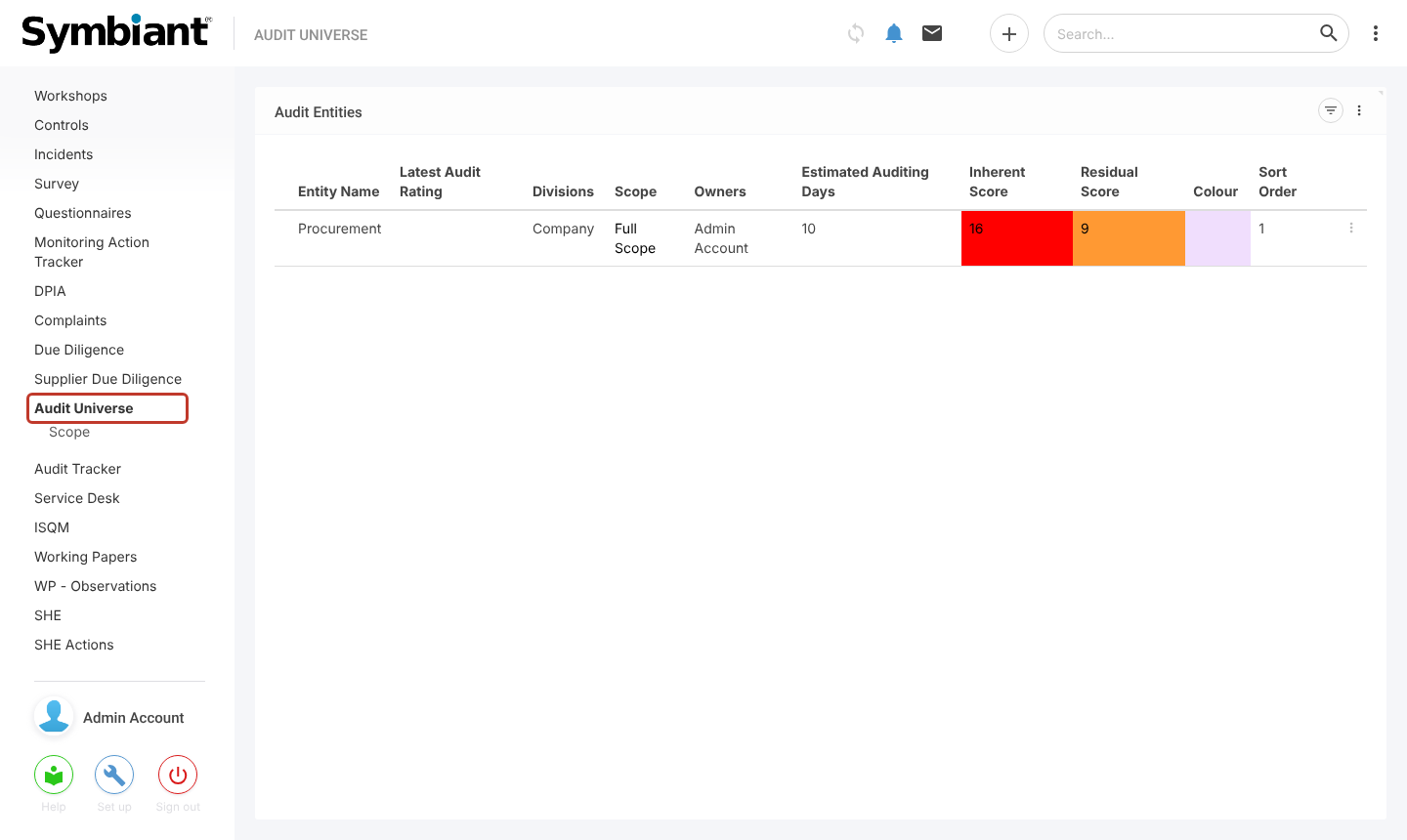
Audit Universe selected in the left menu, showing the Audit Entities list

Reading the Audit Entities List #

Each row is one audit entity. The columns show:

  • Entity Name and the Latest Audit Rating, the rating from its most recent audit.
  • The Divisions, Scope and Owners of the entity.
  • Estimated Auditing Days, the time an audit of this area is expected to take.
  • The Inherent Score and Residual Score, coloured using the entity’s score set, so the riskiest areas stand out.
  • The Colour and Sort Order used to display the entity.

The column headings of the Audit Entities list

Tip: Use the filter icon at the top right of the list to narrow it down, for example to one division.

Inside an Audit Entity #

Click an entity to open it. Its tabs are:

  • Overview: the entity’s details and linked risks at a glance.
  • Edit Audit entity: change the name, divisions, score set, sources, estimated days, scope and owners.
  • Attachments: supporting documents.
  • Risk Scoring: the inherent, residual and target scores.
  • Linked Risks: risks from the risk register that relate to the entity.
  • Audit Connections: the audit reports and working papers for the entity.
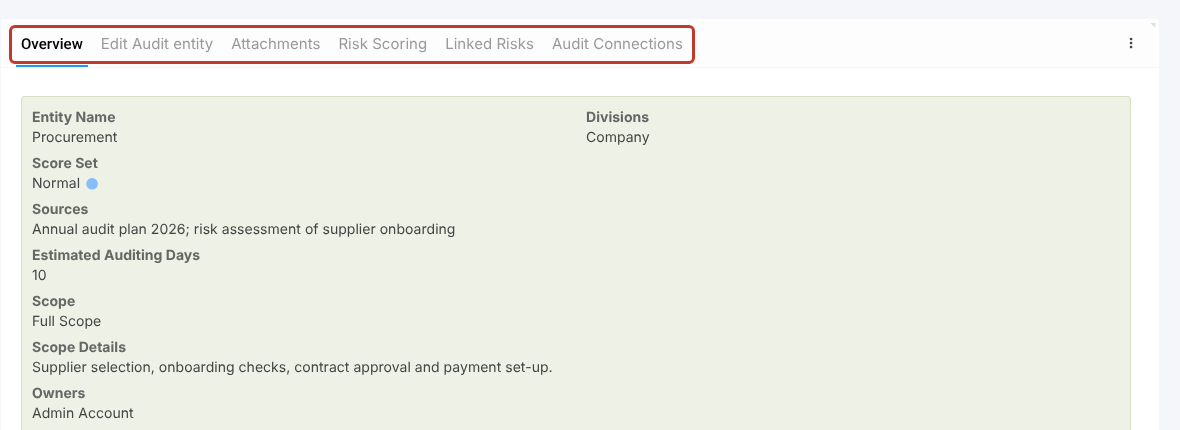
The tabs on an audit entity

Audit Connections #

The Audit Connections tab shows the audit history of the entity. Linked Audit Reports lists the audit reports raised against it, with their audit date. Linked Working Papers lists its working papers, with their rating and start and end dates.
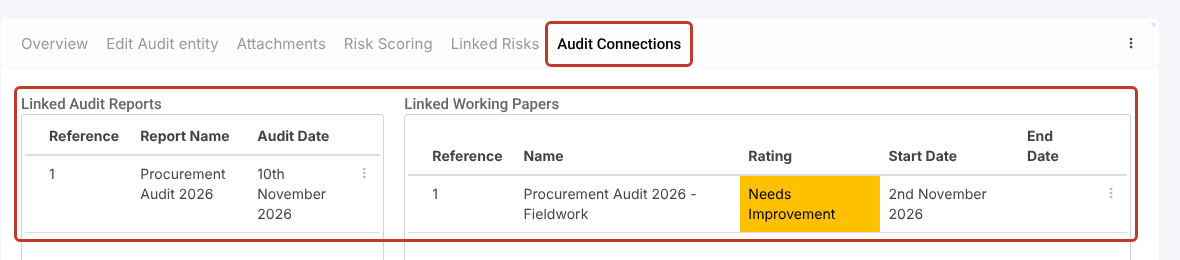
The Linked Audit Reports and Linked Working Papers on the Audit Connections tab

Tip: An administrator can change the scope options under Audit Universe > Scope in the left menu.

Related Articles #

  • Creating an Audit Entity
  • Creating an Audit Issue Report
  • Creating a Working Paper
Did this help?

Share This Article :

  • Facebook
  • X
  • LinkedIn
Require Additional Information? Please Contact Support

How can we help?

Updated on 30 October 2026
Generating an Audit Issue Tracker ReportCreating an Audit Entity
Table of Contents
  • How the Audit Universe Fits Together
  • Opening the Audit Universe
  • Reading the Audit Entities List
  • Inside an Audit Entity
  • Audit Connections
  • Related Articles
Symbiant System White Logo

20-22 Wenlock Road

London

N1 7GU

Linkedin
Telephone Numbers
  • UK - 0113 5263 755
  • Support - 0204 5514 735 option 2
  • USA - 347 991 7130
Information
  • Home
  • Knowledge Base
  • Symbiant Website
  • Submit A Ticket
  • Change Requests
  • Support Staff Login

Copyright © 2025 Symbiant All Rights Reserved - Risk, Audit and Compliance Management Software

We use cookies on our website to give you the most relevant experience by remembering your preferences and repeat visits. By clicking “Accept All”, you consent to the use of ALL the cookies. However, you may visit "Cookie Settings" to provide a controlled consent.
Cookie SettingsAccept All
Manage consent

Privacy Overview

This website uses cookies to improve your experience while you navigate through the website. Out of these, the cookies that are categorized as necessary are stored on your browser as they are essential for the working of basic functionalities of the website. We also use third-party cookies that help us analyze and understand how you use this website. These cookies will be stored in your browser only with your consent. You also have the option to opt-out of these cookies. But opting out of some of these cookies may affect your browsing experience.
Necessary
Always Enabled
Necessary cookies are absolutely essential for the website to function properly. These cookies ensure basic functionalities and security features of the website, anonymously.
CookieDurationDescription
cookielawinfo-checkbox-analytics11 monthsThis cookie is set by GDPR Cookie Consent plugin. The cookie is used to store the user consent for the cookies in the category "Analytics".
cookielawinfo-checkbox-functional11 monthsThe cookie is set by GDPR cookie consent to record the user consent for the cookies in the category "Functional".
cookielawinfo-checkbox-necessary11 monthsThis cookie is set by GDPR Cookie Consent plugin. The cookies is used to store the user consent for the cookies in the category "Necessary".
cookielawinfo-checkbox-others11 monthsThis cookie is set by GDPR Cookie Consent plugin. The cookie is used to store the user consent for the cookies in the category "Other.
cookielawinfo-checkbox-performance11 monthsThis cookie is set by GDPR Cookie Consent plugin. The cookie is used to store the user consent for the cookies in the category "Performance".
viewed_cookie_policy11 monthsThe cookie is set by the GDPR Cookie Consent plugin and is used to store whether or not user has consented to the use of cookies. It does not store any personal data.
Analytics
Analytical cookies are used to understand how visitors interact with the website. These cookies help provide information on metrics the number of visitors, bounce rate, traffic source, etc.
SAVE & ACCEPT
Loading...

Insert/edit link

Enter the destination URL

Or link to existing content

    No search term specified. Showing recent items. Search or use up and down arrow keys to select an item.